Composed Image Retrieval (CIR) is motivated by the real-world need to search for target images using a multimodal query
(a reference image combined with text instructions on how to alter it). The fundamental challenge driving our paper is that
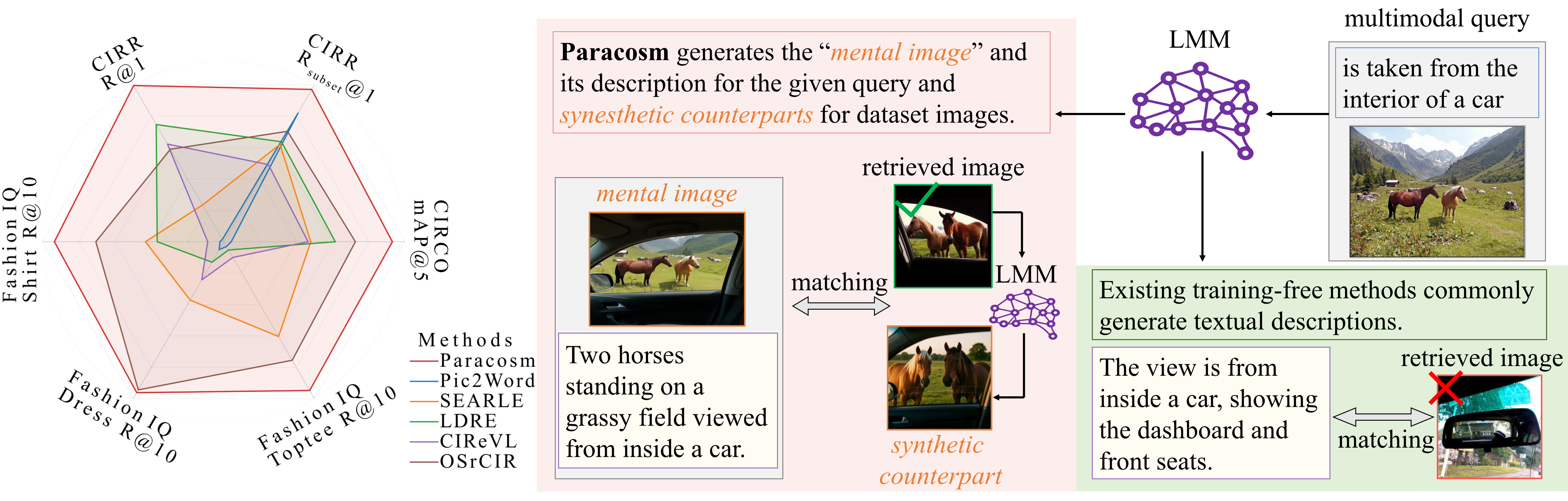
the intended target is merely an implicit "mental image" that does not physically exist in the query.
While current zero-shot methods attempt to solve this by using Large Multimodal Models (LMMs) to translate
the multimodal query into a purely textual description, we point out a major flaw: text descriptions act as an information
bottleneck, stripping away the rich visual details necessary for accurate matching.
To overcome this, we are motivated to address CIR from first principles by directly generating the "mental image"
via image editing. Furthermore, we recognize that introducing a synthetic query image creates a severe synthetic-to-real domain gap
when matched against real database images. This insight drives our final motivation: to preprocess the database images into synthetic
counterparts, creating a balanced, virtual matching space, a "Paracosm", where synthetic-to-synthetic and real-to-real alignment can
successfully occur without requiring any model training.
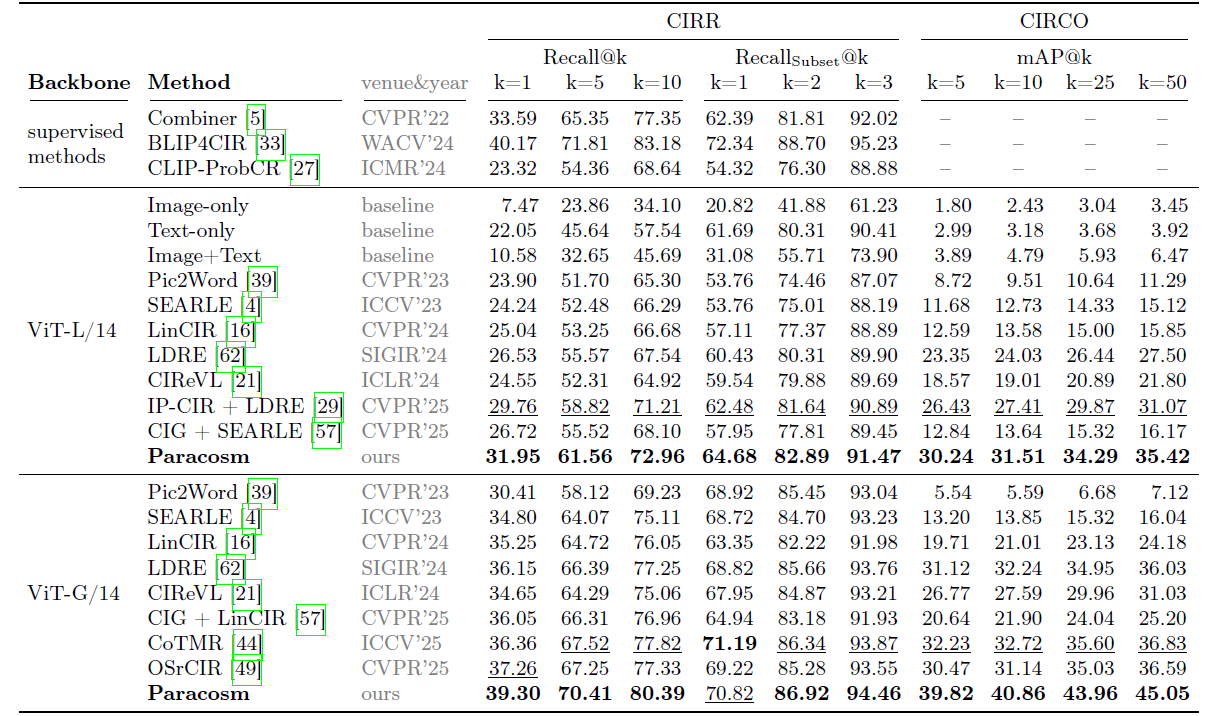
Our extensive evaluations of Paracosm on standard Composed Image Retrieval (CIR) benchmarks yield the following key findings:
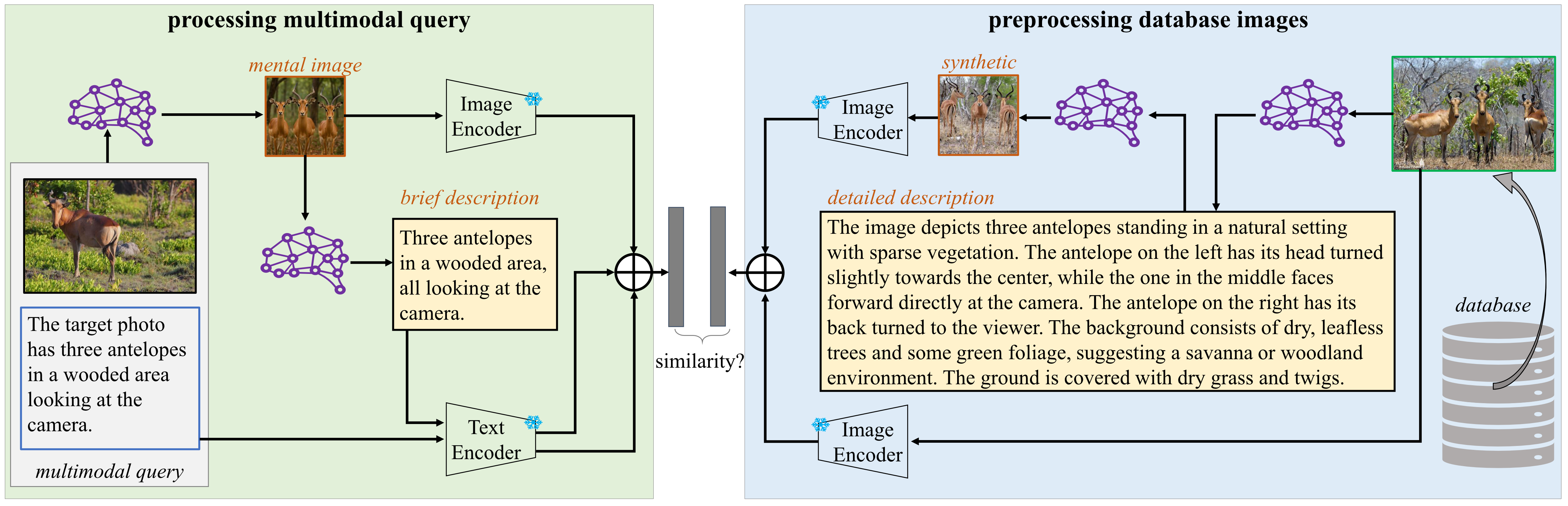
Our framework, Paracosm, is a training-free, zero-shot Composed Image Retrieval (CIR) method that operates by mapping both multimodal queries and database images into a shared virtual space to perform accurate matching from first principles. For the query pipeline, we leverage a Large Multimodal Model (LMM) with image-editing capabilities to directly alter the reference image based on the modification text, generating a "mental image" alongside a concise, single-sentence visual description. Concurrently, to eliminate the synthetic-to-real domain gap, our database pipeline processes each real image offline by extracting a highly detailed LMM description and passing it into a text-to-image generator to create a synthetic counterpart. Finally, we employ a pretrained Vision-Language Model to extract and fuse features from both real and synthetic representations of the queries and database images, computing their cosine similarity to retrieve the optimal target image without requiring any fine-tuning.
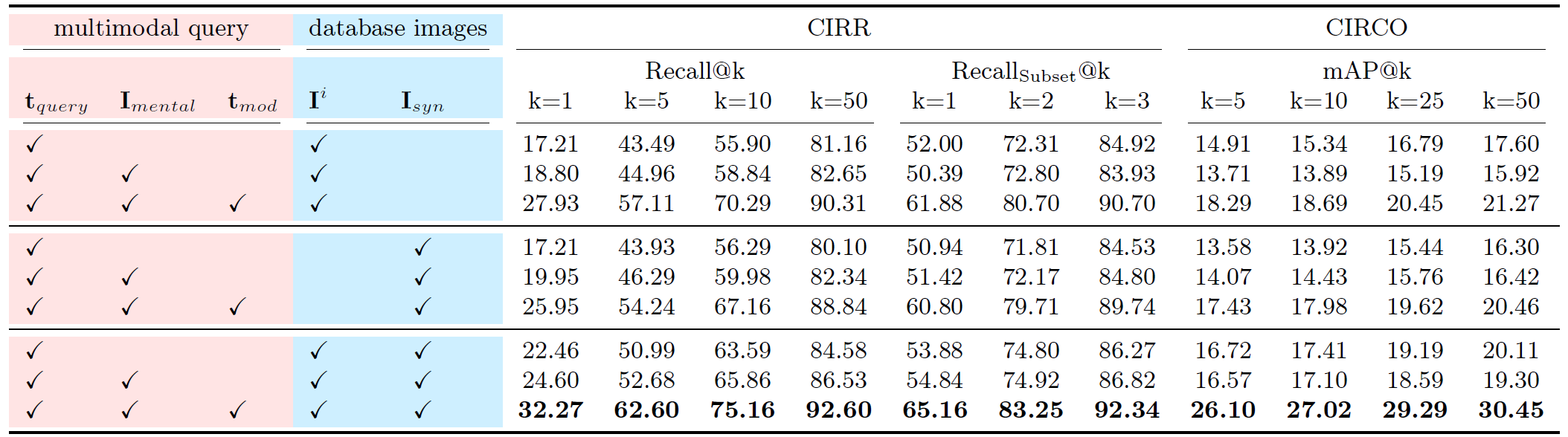
Remarkably, we show that:
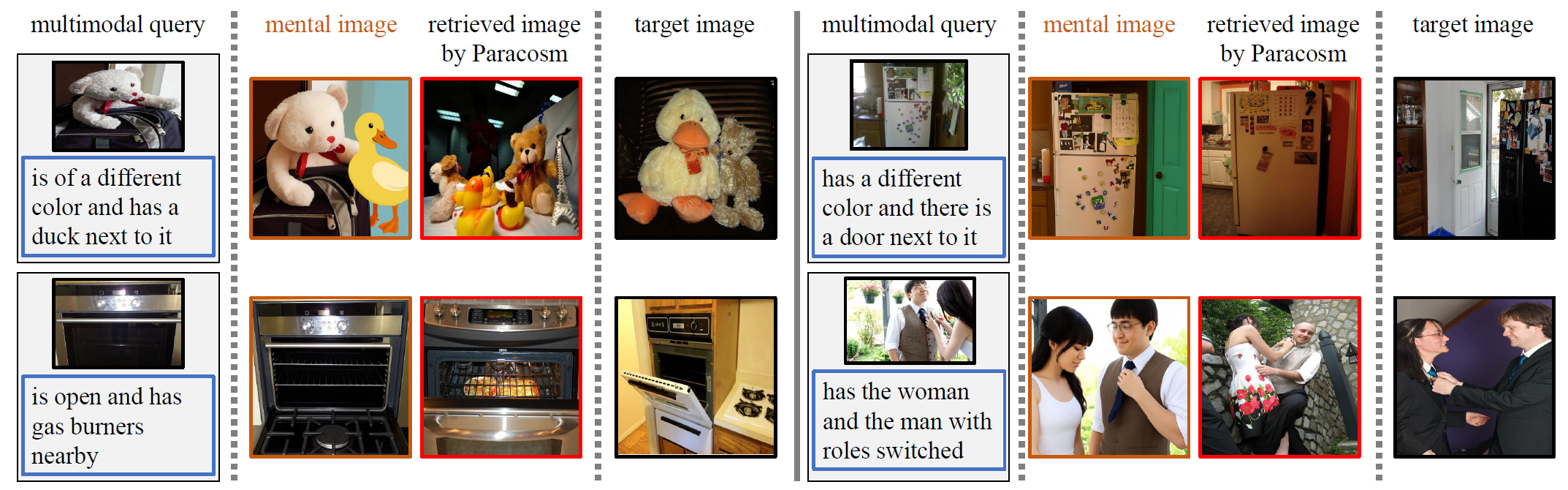
Paracosm can fail due to limitations of generative models that can generate implausible and counterfactual mental images. Four examples, respectively, demonstrate different failures of Paracosm. (1) It incorrectly generates a cartoon-style duck, making it fail to return the correct database image, which captures a plush toy duck. (2) It generates a counterfactual oven that has gas burners on its door, making it incorrectly retrieve an image that captures a burning oven. (3) It fails to edit the door color of the specified refrigerator and hence fails to return the correct target image. (4) It fails to comprehend the multimodal query, resulting in an incorrect mental image and hence failing to return the target image.
If you find our work useful, please consider citing our papers:
@inproceedings{wang2026paracosm,
title={Generating a Paracosm for Training-Free Zero-Shot Composed Image Retrieval},
author={Tong Wang and Yunhan Zhao and Shu Kong},
booktitle={European Conference on Computer Vision (ECCV)},
year={2026}
}